

Article: How to Choose and Measure a Curtain Rod: A 2026 Buying Guide
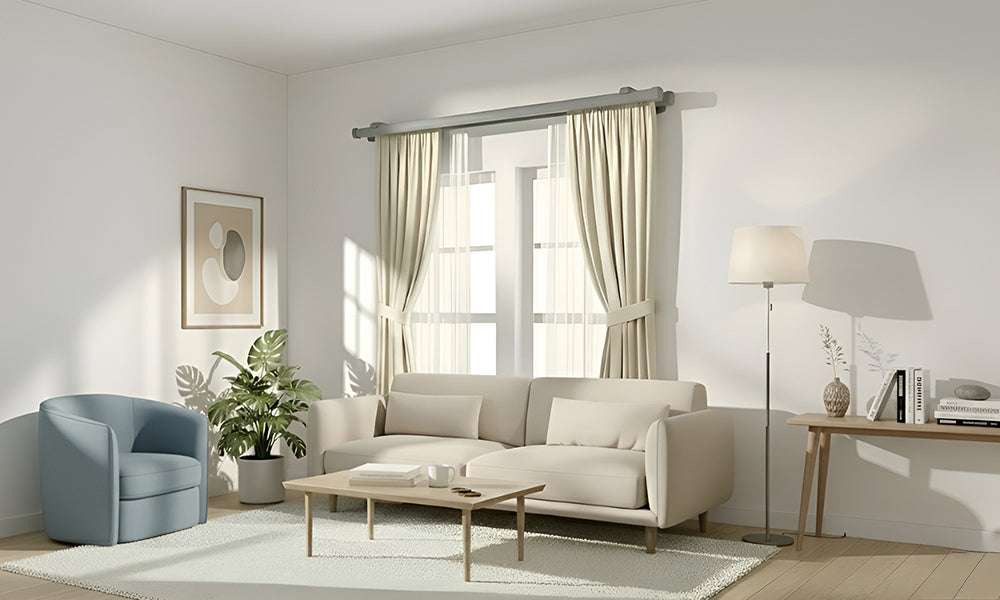
How to Choose and Measure a Curtain Rod: A 2026 Buying Guide
To choose the right curtain rod, measure your window width and add 15–20 cm on each side, mount the rod 10–15 cm above the frame, and match the rod's diameter and type (single or double) to the weight and number of curtain layers you want to hang. The guide below walks through every step, with exact measurements.
How do you measure a window for a curtain rod?
Start with the width. Measure the window opening at its widest point, then add 15–20 cm of "stack-back" on each side. This overhang lets the curtains sit clear of the glass when open, so you get full daylight and the window looks wider than it really is.
A window that is 120 cm wide, for example, is best paired with a rod of roughly 150–160 cm. The extra width is not wasted space — it is what makes a room feel taller and more finished.
Measure with a steel tape rather than a fabric one, take the width in three places (top, middle, bottom), and use the largest figure. Older walls are rarely perfectly square, and the widest measurement keeps your curtains from catching.
How high should a curtain rod be mounted?
Mount the rod 10–15 cm above the top of the window frame. Hanging higher than the frame draws the eye upward and makes the ceiling feel taller — one of the simplest ways to make a room look more spacious.
For a dramatic, designer look in rooms with tall walls, you can mount the rod roughly halfway between the frame and the ceiling. Whatever height you choose, keep it consistent across windows on the same wall so the tops of your curtains line up.
Then decide on drop (length). Floor-length curtains that just kiss the floor suit most living rooms and bedrooms; a 1–2 cm gap makes daily opening easier and keeps hems clean.
What rod diameter and length do you actually need?
Diameter determines how much weight a rod carries and how substantial it looks. Thin rods suit light sheers; thicker profiles support heavy, lined drapery without sagging and look proportionate on larger windows.
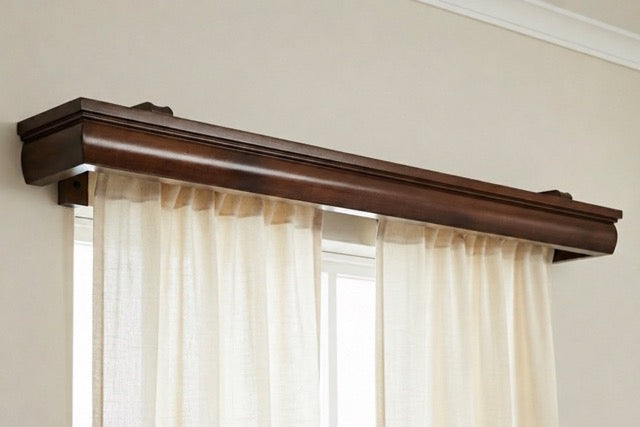
Domino Deco rods use a solid linden-wood oval profile measuring 3.5 × 4.5 cm, with a discreetly integrated aluminium track inside. The oval shape gives a generous visual presence while the hidden track does the mechanical work, so curtain hooks glide quietly and smoothly.
For length, Domino systems come in 1–2 m (single piece) and 2–4 m (two pieces), and can be custom-made to size. Splitting longer spans into two sections, joined with a centre support, prevents the bowing you see on cheap one-piece rods over wide windows. Explore the full range of solid wood curtain and track systems to compare profiles.

Single or double curtain rod — which should you choose?
Choose a single rod if you want one layer of curtains; choose a double rod if you want two layers — typically a sheer behind a heavier drape. A double system gives you privacy and light control in one elegant fitting.
The Domino Single wooden curtain rod is designed for one curtain layer and is the everyday choice for most rooms. On the wall it projects 14 cm, with an 8 × 10 cm bracket base.
The Domino Double wooden curtain rod & track system carries two layers: the inner rail sits 10 cm from the wall for the sheer, and the outer rail 18 cm out for the drape. That 8 cm gap is what lets both textiles move freely without brushing each other.
As a rule of thumb: bedrooms and street-facing living rooms benefit most from a double rod, while a single rod is perfect where you only need decoration or basic light control.
Should you mount on the wall or the ceiling?
Wall mounting is the standard and works in almost every room. Ceiling mounting is the better choice when there is little space above the window, when you want floor-to-ceiling drama, or when a radiator or moulding sits in the way.
Domino rod and track systems are available in both wall and ceiling versions, so you can keep the same look throughout a home even when individual windows demand different fittings. Ceiling mounting also visually stretches a low room, because the fabric runs the full height of the wall.
What material and finish should you pick?
Material sets the tone of the whole window. Solid wood reads warm and natural and suits almost every interior, from classic to Japandi and Scandinavian; it is also the defining trend for 2026, as warm, natural materials replace cold metal "sticks".
Every Domino rod is made from solid linden wood and finished in one of ten colours: White, Black, Anthracite Grey, Light Grey, Natur, Walnut, Oak, Golden Oak, Wenge and Ash. Pale finishes such as Natur, Oak and White keep a room light and airy; Black, Wenge and Anthracite Grey add contrast and a contemporary edge.
A quick styling tip: match the rod to your larger wood tones (floor, furniture) for a calm, cohesive look, or deliberately contrast it against the wall colour when you want the window to stand out as a feature.
What about bay, corner, or angled windows?
Standard straight rods cannot follow the angles of a bay or corner window, which is where most shoppers get stuck. The solution is a rod made to the exact angle of your window.
Domino Deco manufactures rods to custom sizes, colours and angles on request, so bay, corner and non-standard windows get a continuous, made-to-measure run rather than a compromise. If your window is anything other than a simple rectangle, send the measurements and angle and ask for a custom quote.
A simple step-by-step for choosing your rod
First, measure the window width and add 15–20 cm per side. Second, decide your mounting height (10–15 cm above the frame, or higher for drama) and whether you are mounting on the wall or ceiling. Third, choose single or double depending on how many curtain layers you want. Fourth, pick your finish from the ten available colours. Finally, if the window is wide, bayed or angled, request a custom size.
If you prefer a slimmer round profile, the 35 mm wooden curtain rods are a lighter alternative, and the decorative valance track systems add a finished pelmet that hides the track entirely.
Common curtain rod mistakes to avoid
The most frequent mistake is buying a rod the same width as the window, which leaves the curtains bunched over the glass and makes the room darker. The second is fixing the rod directly onto the frame instead of 10–15 cm above it, which visually lowers the ceiling and shortens the wall.
A third common error is hanging heavy, lined drapery on an undersized rod, which leads to sagging over time. Match the rod profile and the number of brackets to the fabric weight, and split any span wider than about 2 m into two supported sections — exactly how Domino delivers longer runs. Finally, measure every window individually: even windows that look identical often differ by a centimetre or two.
Frequently asked questions
How much wider than the window should a curtain rod be?
Add 15–20 cm on each side of the window opening, so a 120 cm window pairs with a rod of about 150–160 cm. This lets curtains stack clear of the glass when open and makes the window look larger.
How high above the window should I hang the rod?
Mount the rod 10–15 cm above the frame. For a taller, more dramatic effect on high walls, you can position it roughly halfway between the frame and the ceiling.
What is the difference between a single and double curtain rod?
A single rod holds one curtain layer; a double rod holds two — usually a sheer on the inner rail and a heavier drape on the outer rail — giving you both daylight and privacy from one fitting.
Can I get a curtain rod for a bay or angled window?
Yes. Domino Deco makes rods to custom sizes and angles on request, so bay, corner and non-rectangular windows can have a continuous, made-to-measure rod.
What are Domino curtain rods made of?
They are made from solid linden wood with an oval 3.5 × 4.5 cm profile and a discreetly integrated aluminium track, so hooks glide smoothly and quietly. They come in ten finishes and in wall or ceiling versions.
Ready to choose your rod?
Browse the wooden curtain & track systems to find your finish, or — for wide, bay or angled windows — The Domino Deco team


%20to%20the%20wei...)